Which Milk Is Best for Your Family? Homogenised vs Un-Homogenised
A practical guide to the science, flavour, cooking performance, and family uses of homogenised and un-homogenised milk.
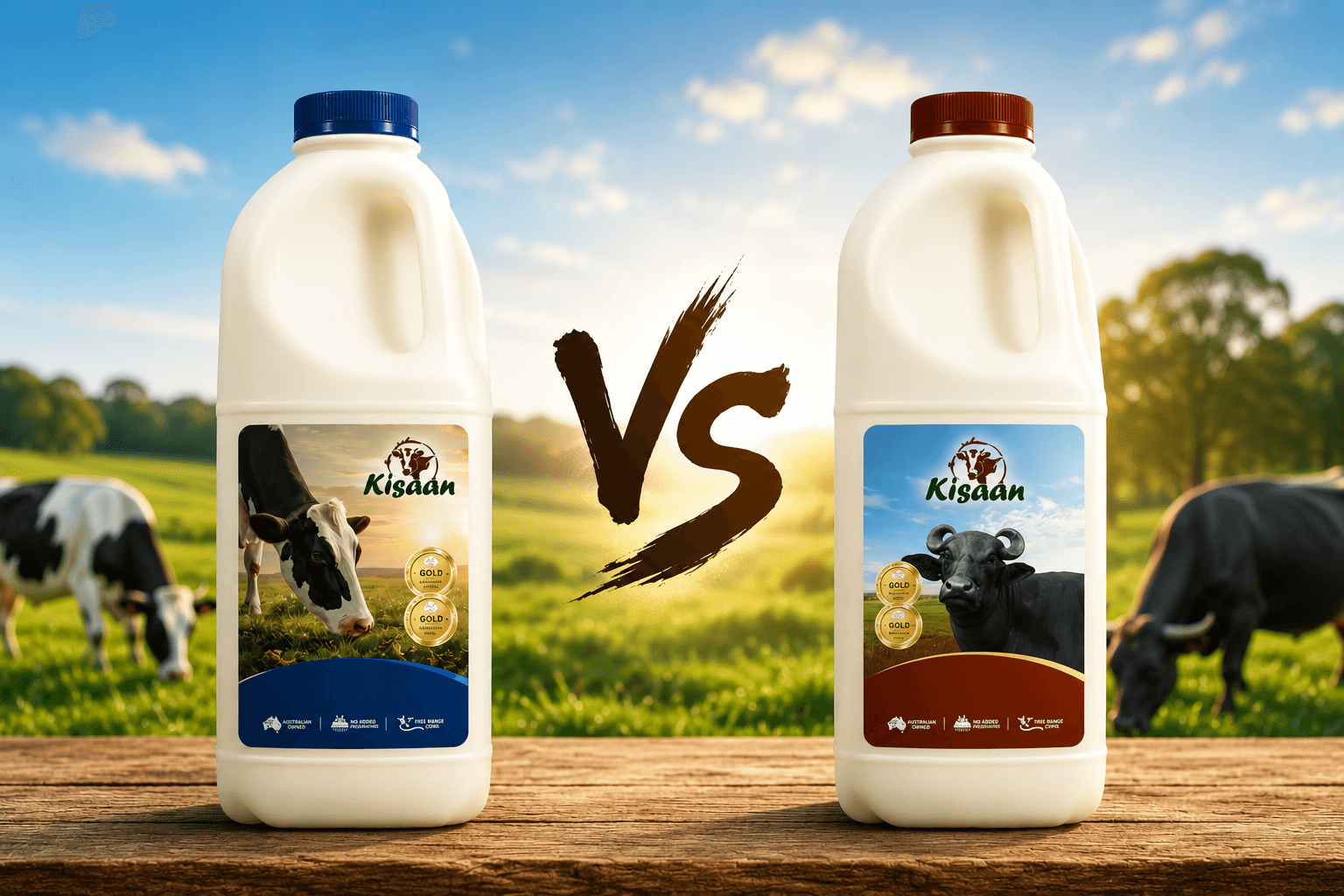
For a long time, buying milk in Australia felt simple. Most families chose between full cream, low fat, and skim, then moved on with the weekly shop. But as more households look for fresher, less industrial dairy, another question is becoming much more important: should your milk be homogenised or un-homogenised?
If you have opened a bottle and seen a thick, gold-tinted cream layer sitting on top, you have experienced un-homogenised milk in its traditional form. If your milk pours with the same smooth texture from the first glass to the last, it has been homogenised.
At Kisaan, our roots go back to generations of traditional farming. From our independent dairy network in Victoria's Goulburn Valley, we offer both smooth homogenised options and rich cream-on-top un-homogenised milk so households can choose what works for their taste, routine, and cooking style.
What Is Homogenisation?
Fresh milk is a natural emulsion of water, proteins, carbohydrates, minerals, vitamins, and suspended fat particles. Those fat particles are lighter than the surrounding liquid, so when milk is left alone they naturally float upwards and gather at the surface. That is how the traditional cream layer forms.
Homogenisation is a mechanical process. During processing, pasteurised milk is pushed through tiny valves under high pressure. This breaks the larger fat globules into much smaller, more uniform particles.
Once the fat particles are smaller and evenly distributed, they no longer rise and bind together in the same way. Instead, they remain suspended throughout the milk, creating the consistent texture most supermarket shoppers are used to.
Homogenised Milk: Smooth, Simple, and Consistent
Homogenised milk is the dominant format on major supermarket shelves because it suits modern retail and busy household routines. It looks the same through the bottle, pours predictably, and does not require shaking before use.
Its biggest strengths are practical:
- Same texture and richness in every pour
- No shaking, stirring, or cream mixing needed
- Reliable look and mouthfeel through the bottle
- A lighter feel that suits chilled everyday drinking
This makes homogenised milk especially useful for school mornings, cereal, protein shakes, smoothies, baking, lunchbox thermoses, and households where children prefer a completely uniform texture.
Kisaan's homogenised range includes lighter daily milk and organic options for families who want the convenience of a smooth pour with the quality standards of carefully sourced Australian dairy.
Un-Homogenised Milk: Cream on Top and Full-Bodied Flavour
Un-homogenised milk skips the high-pressure homogenisation step after pasteurisation. The natural fat structure stays intact, which means the cream rises to the top over time.
For many families, that cream layer is the whole point. You can spoon it into coffee, add it to porridge, use it with desserts, or shake it back into the bottle for a rich, full-cream drinking experience.
Un-homogenised milk is loved for:
- A visible cream layer that signals minimal processing
- A deeper, more traditional dairy flavour
- Excellent behaviour in slow cooking and fermentation
- A nostalgic cream-on-top experience for the table
It is also a strong choice for homes that cook from scratch. Intact milk solids and fat structures perform beautifully in slow stovetop recipes, traditional chai, thick dahi, homemade yoghurt, paneer, kheer, rabdi, and kulfi.
Kisaan's un-homogenised selection includes full cream cow milk and un-homogenised buffalo milk, both designed for families who want dairy closer to its old-school farm-fresh character.
Homogenised vs Un-Homogenised Milk at a Glance
| Feature | Homogenised Milk | Un-Homogenised Milk |
|---|---|---|
| Cream separation | None. The fat stays evenly suspended in the milk. | Yes. A natural cream layer rises to the surface. |
| Physical texture | Smooth, light, and consistent from first pour to last. | Full-bodied, rich, and naturally varied through the bottle. |
| Processing path | Pasteurisation followed by high-pressure mechanical homogenisation. | Pasteurisation only, with the natural fat structure left intact. |
| Mouthfeel and taste | Clean, crisp, and predictable for everyday drinking. | Deep, rounded, naturally sweet, and cream-forward. |
| Best uses | Cereal, smoothies, lunchboxes, baking, and daily drinking. | Chai, coffee, dahi, paneer, kheer, kulfi, and rich desserts. |
| Handling | Pour straight from the fridge. | Shake before pouring, or spoon off the cream to use separately. |
Does Homogenisation Change the Nutrition?
This is one of the most common questions families ask. The short answer: the main change is physical, not nutritional.
Homogenisation changes the size and distribution of milk fat globules. It does not turn milk into a chemically different food. Protein, calcium, minerals, and naturally occurring vitamins remain part of both homogenised and un-homogenised milk.
That means the decision is less about one being nutritionally "better" and more about what your family values: convenience and uniform texture, or a richer cream-on-top experience with stronger traditional cooking performance.
Which One Works Better in the Kitchen?
Coffee and Flat Whites
Homogenised milk is reliable for busy cafes because it foams predictably and creates stable microfoam. It is easy to work with and consistent from bottle to bottle.
Un-homogenised milk gives a different experience. When heated gently, its intact fat structure can create a velvety mouthfeel and natural dairy sweetness that pairs beautifully with dark roast coffee.
Indian Chai
For stovetop chai, un-homogenised milk has a clear advantage. It has the body to bind with strong black tea, ginger, cardamom, and other spices. Simmered slowly, it reduces into a silky, comforting cup with the weight many families associate with traditional chai.
Mithai, Dahi, and Paneer
For kheer, kulfi, rabdi, homemade dahi, and paneer, un-homogenised full cream milk is often the better tool. As it simmers, the milk thickens naturally and develops a richer flavour. Homogenised milk can still be used, but it may take longer to reduce or deliver a lighter final texture.
Why Buffalo Milk Is Becoming Popular
Australian families with South Asian cooking traditions are also rediscovering buffalo milk. Compared with standard cow milk, buffalo milk is naturally thicker and richer, with higher milk solids and a deep cream layer when left un-homogenised.
Kisaan un-homogenised buffalo milk is valued for:
- Higher milk solids for a naturally thicker body
- A rich cream layer when kept un-homogenised
- Strong performance for thick dahi and homemade paneer
- A satisfying option for traditional chai and Indian sweets
If your household regularly makes chai, dahi, paneer, or festive sweets, buffalo milk can be the premium choice. For everyday cold drinking or cereal, cow milk may feel lighter and more familiar.
How to Choose for Your Household
There is no single correct answer. The right milk depends on the way your family drinks, cooks, and shops.
Choose Homogenised Milk If
- You want milk that pours the same every time.
- Your children prefer a smooth, lightweight texture.
- You need quick milk for cereal, smoothies, and lunchboxes.
- You do not want to shake the bottle before serving.
Choose Un-Homogenised Milk If
- You love natural cream on top.
- You prefer whole foods with minimal processing.
- You make chai, dahi, paneer, kheer, or desserts at home.
- You want a richer, more traditional dairy flavour.
The Kisaan Promise
Kisaan believes Australian families should have honest access to dairy that suits both modern convenience and traditional cooking. Some households need the predictable pour of homogenised milk. Others want the nostalgic luxury of cream on top.
Our job is to make both choices fresh, transparent, and easy to bring home. Explore our range of milk, dahi, yoghurt, paneer, and pure desi ghee through Kisaan home delivery or independent retail partners across Melbourne.
Frequently Asked Questions
Is un-homogenised milk raw milk?
No. Kisaan un-homogenised milk is pasteurised for safety. Pasteurisation uses controlled heat to reduce harmful bacteria, while homogenisation is a separate mechanical pressure step that changes fat-particle size and texture.
Do I need to shake un-homogenised milk before using it?
Only if you want the cream mixed back through the bottle. Shake firmly for a richer, more even pour, or leave the bottle unshaken and spoon the cream from the top.
Does homogenisation change the nutrition of milk?
Homogenisation mainly changes the physical size and distribution of milk fat globules. The choice between homogenised and un-homogenised milk is mostly about texture, flavour, handling, and cooking performance.
Which milk is better for toddlers and young children?
Both can suit growing families. Full cream un-homogenised milk gives a richer cream-on-top experience, while homogenised milk is convenient for children who prefer a lighter and fully uniform texture.
Why does Kisaan source from the Goulburn Valley?
The Goulburn Valley in Victoria is known for fertile pastures and strong dairy-farming heritage. Kisaan works with local farmers in this region to support regional agriculture and deliver fresh dairy to Australian households.